Equipment use documented
Fender Stratocaster
Original knob values: unknown. Numerical suggestions await further version and control references for this item.
Check the era, documented model and limits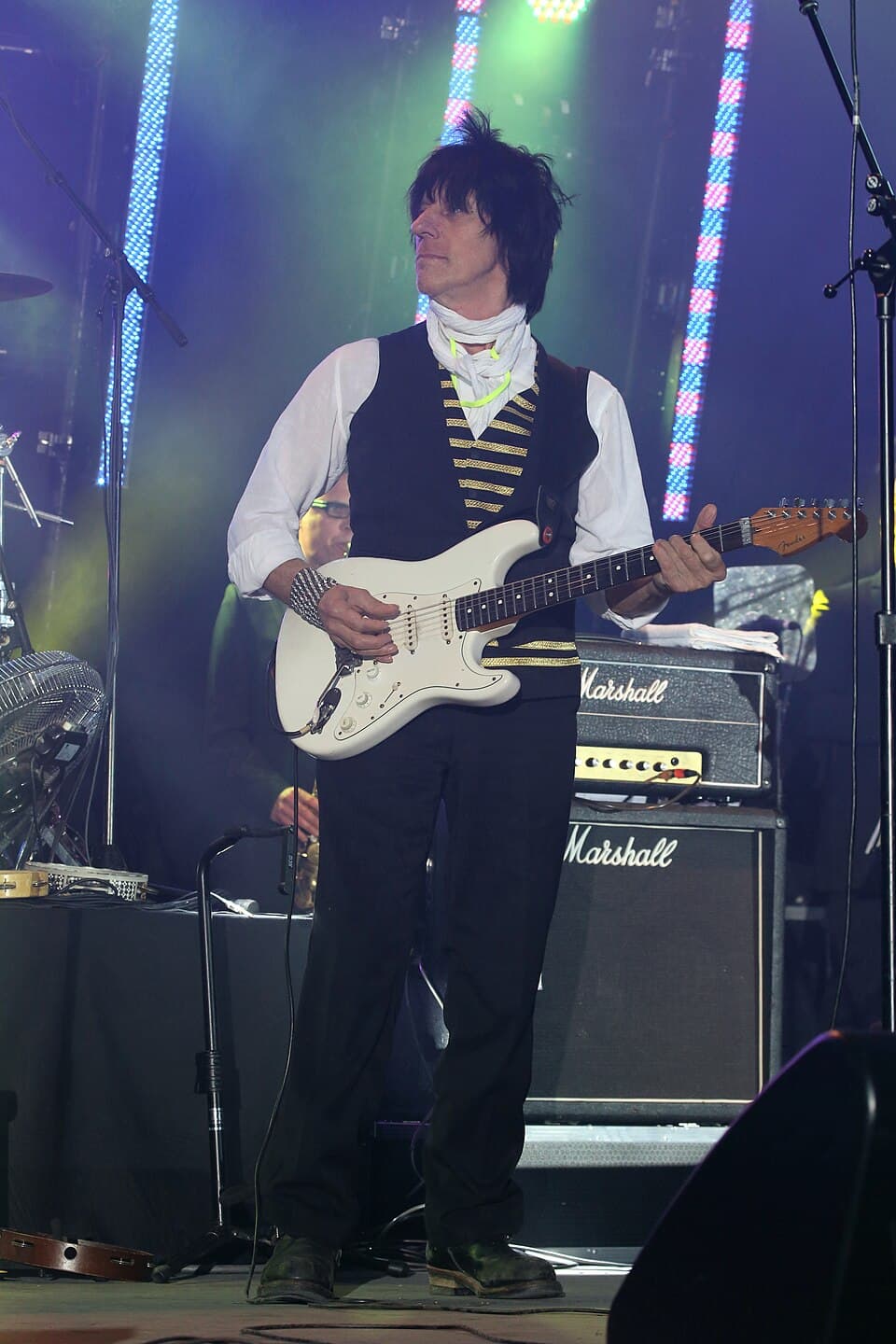 ARTIST / 11
SOLO ARTIST / THE YARDBIRDS — BLUES / FUSION
Finger-picked expression, harmonics and volume swells that flow like a human voice.
Later Strat lead · harmonics and volume expression
MATCH THE HARDWARE FIRST
Reference the DSL50 and 1960BX / Greenback 25W in the 1999 interview. Preserve the DSL50 gain description, ‘about one o’clock’. Channel and mode are not inferred, and this is not converted into a JCM800 value.
Equipment basis and value provenance are separate. Suggested values for matching hardware are still not verified artist settings.
Studio and live rig described in the 1999 interview
Original knob values: unknown. Numerical suggestions await further version and control references for this item.
Check the era, documented model and limitsOriginal knob values: unknown. Numerical suggestions await further version and control references for this item.
Check the era, documented model and limitsOriginal knob values: unknown. Numerical suggestions await further version and control references for this item.
Check the era, documented model and limitsBeck describes the gain position as approximately one o’clock.
The clock position has not been converted into a 0–10 number.
Read the original account ↗The substitute path provides a full simplified chain and suggested values for alternative gear.
DOCUMENTED USE
Confirmation applies only to the stated era and claim. It does not validate a complete recording rig or our modeler presets.
Beck describes using his surf-green Strat on most tracks.
He identifies a 50-watt DSL50 for recording and live use.
This does not establish the original Where Were You session rig.
The interview specifies a 1960BX cabinet with 25-watt Greenbacks.
Beck describes the gain position as approximately one o’clock.
The clock position has not been converted into a 0–10 number.
Account / record by: Jeff Beck
Period / original record: 1999-05 · Published: 2023-12-25 · Source reviewed: 2026-09-13
Reference photos are separate from evidence of actual use. See photo credits for the original images and reuse terms.
Start with the connections. Guitar → modeler INPUT → headphones or FRFR. Use both amp and cabinet simulation. For a physical guitar speaker, disable cabinet simulation and adjust the output mode.
The proposal fits within HX Stomp’s eight-block count. Actual DSP use still needs testing; omit optional modulation if necessary.
Tone and gain values are normalized 0–10 starting points. If the device uses a different range, begin at a similar proportion; this is not an acoustic equivalence. Time, frequency and mix retain their shown units. Leave unlisted parameters at defaults.
Use Marshall crunch as an alternative to a dedicated DSL50 model. Preserve the response to guitar volume and finger dynamics.
For headphones / FRFR. Cabinet choices are tonal alternatives, not necessarily the original touring speakers. If QC lacks the cut filters here, use a separate Low-High Cut block.
An editorial placement for clear repeats. This does not establish that the artist used this delay time on a recording or tour.
An editorial ambience suggestion, not evidence of use on a recording or tour.
Model names based on Helix 3.80
Official model / parameter documentation