Equipment use documented
Custom Strat-style guitar · single humbucker
- VolumeSuggested start
- 10 / 10
The values above are playing suggestions. Actual artist knob positions remain unknown.
Check the era, documented model and limits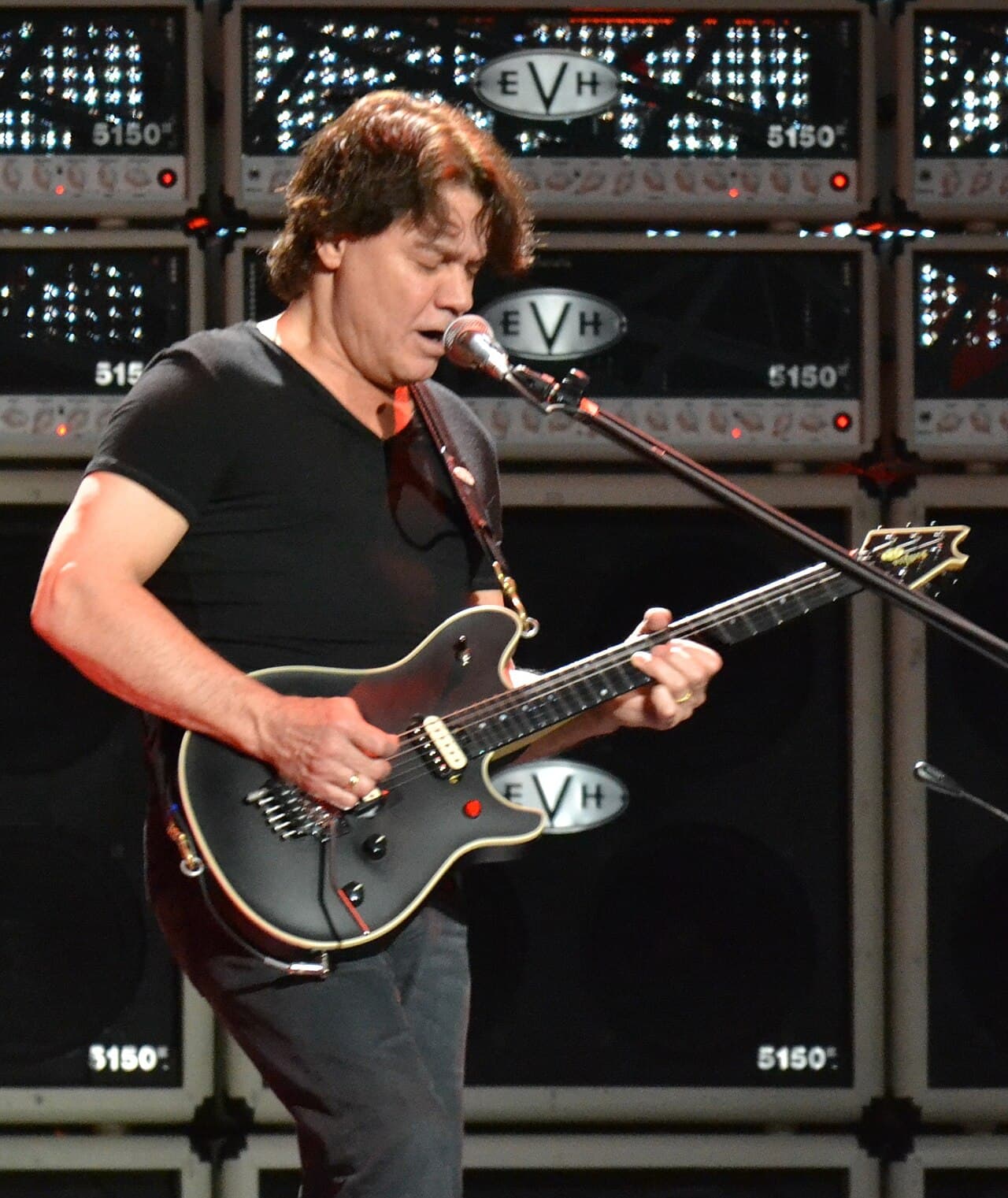 ARTIST / 09
VAN HALEN — HARD ROCK / SHRED
A driven amp and a slow phaser, with expressive dynamics that remain under the fingers.
An early brown-sound riff study
MATCH THE HARDWARE FIRST
Use the documented single-humbucker custom guitar and Phase 90 as the reference. Do not add an imaginary tone control to a volume-only layout. The 1978 amp statement is retained as a historical account, not a starting output setting for current equipment.
Equipment basis and value provenance are separate. Suggested values for matching hardware are still not verified artist settings.
1978 artist interview and 2014 recollection of MXR use
The values above are playing suggestions. Actual artist knob positions remain unknown.
Check the era, documented model and limitsOriginal knob values: unknown. Numerical suggestions await further version and control references for this item.
Check the era, documented model and limitsOriginal knob values: unknown. Numerical suggestions await further version and control references for this item.
Check the era, documented model and limitsIn the 1978 interview he describes turning the amp controls fully up.
His account is preserved without conversion into guide values.
Read the original account ↗The substitute path provides a full simplified chain and suggested values for alternative gear.
DOCUMENTED USE
Confirmation applies only to the stated era and claim. It does not validate a complete recording rig or our modeler presets.
In 1978 he describes a custom guitar with one humbucker and one volume control.
Distinguish current replicas and later specifications.
The official 2014 interview excerpt explicitly identifies Phase 90 use.
The EVH90 reference photo is not his early unit.
He describes rebuilt Marshalls without an exact model number.
Plexi remains a recreation choice; exact circuits and modifications remain unresolved.
In the 1978 interview he describes turning the amp controls fully up.
His account is preserved without conversion into guide values.
These sources do not establish our complete numerical guide as the artist’s actual settings.
Suggested values are starting points, not verified original recording settings.
Account / record by: Eddie Van Halen
Period / original record: 1978 · Published: 2020-10-06 · Source reviewed: 2026-09-13
Account / record by: Eddie Van Halen interview · official EVH excerpt
Period / original record: 2014-11 · Published: 2014-10-29 · Source reviewed: 2026-09-13
Reference photos are separate from evidence of actual use. See photo credits for the original images and reuse terms.
Start with the connections. Guitar → modeler INPUT → headphones or FRFR. Use both amp and cabinet simulation. For a physical guitar speaker, disable cabinet simulation and adjust the output mode.
The proposal fits within HX Stomp’s eight-block count. Actual DSP use still needs testing; omit optional modulation if necessary.
Tone and gain values are normalized 0–10 starting points. If the device uses a different range, begin at a similar proportion; this is not an acoustic equivalence. Time, frequency and mix retain their shown units. Leave unlisted parameters at defaults.
Place before the amp with a four-stage / Script character. Start QC in 90 mode. Bypass if the riff loses definition.
A Plexi-based early brown-sound proposal. It does not reproduce the physical amp modifications or power conditions.
For headphones / FRFR. Cabinet choices are tonal alternatives, not necessarily the original touring speakers. If QC lacks the cut filters here, use a separate Low-High Cut block.
An editorial placement for clear repeats. This does not establish that the artist used this delay time on a recording or tour.
An editorial ambience suggestion, not evidence of use on a recording or tour.
Model names based on Helix 3.80
Official model / parameter documentation