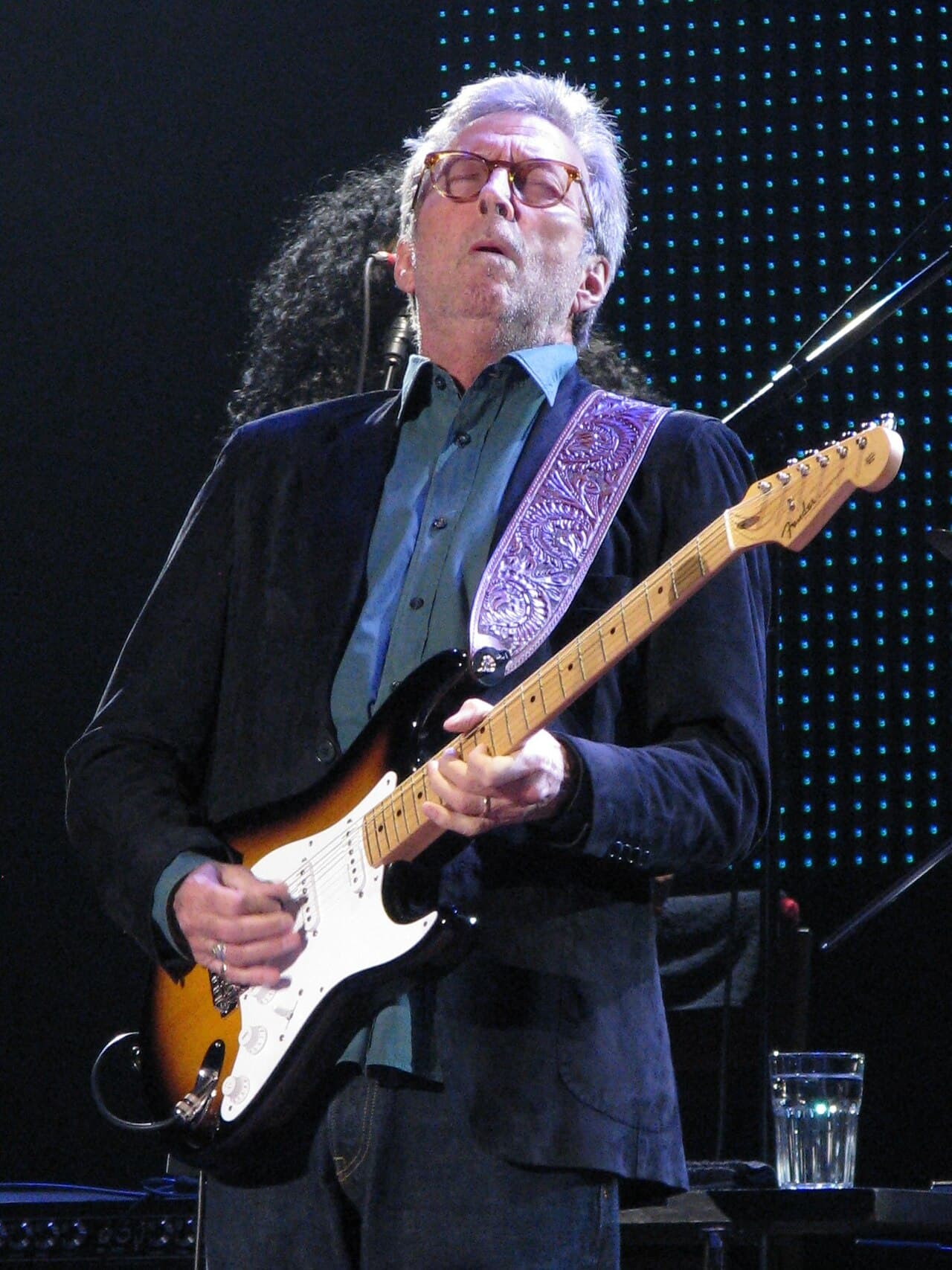
A soft attack, short phrases and generous space. A blues lead that sings at low gain.
RECREATION STUDY
Wonderful Tonight
Later Strat clean-lead character
Suggested pickupNeck single-coil
♮TuningE A D G B E
Suggested values are starting points for recreation.
MATCH THE HARDWARE FIRST
Start with the instrument’s own controls
This path uses the current Eric Clapton Stratocaster specification: Vintage Noiseless SSS, TBX and active Mid Boost. The 2005 Strat / ’57 Twin record and factory specifications are separate evidence; neither establishes the 1977 Wonderful Tonight recording settings.
Equipment basis and value provenance are separate. Suggested values for matching hardware are still not verified artist settings.
A reduced connection proposal using factory specifications, not a copy of the complete touring wiring.
Strat use documented · signature is the spec reference
Fender Eric Clapton Stratocaster
Playing reference: current signature factory specification · use record: 2005 Strat
TBX has a center detent at 5; above it the response adds brightness and presence. Distinguish earlier Lace Sensor versions from current Vintage Noiseless versions. Mid Boost acts before the amp input.
VolumeSuggested start
7 / 10
TBXSuggested start
5 / 10
Start at the center detent. This is not equivalent to a conventional tone knob at 5.
Mid BoostSuggested start
0 / 10
A knob position. Do not linearly convert the maximum 25 dB specification into a 0–10 scale.
The values above are playing suggestions. Actual artist knob positions remain unknown.
A proposal using the factory ’57 Twin’s control names and clock positions, starting without Bright input or channel jumpering. There are no Middle, Gain or Reverb knobs. Personal amp modifications and actual values remain unknown.
InputSuggested start
Normal 2
The -6 dB input in the ’57 Twin manual. Suggested for active-guitar headroom; the artist’s actual input is unknown.
Volume · NormalSuggested start
9 o’clock
Volume · BrightSuggested start
Minimum
BassSuggested start
11 o’clock
TrebleSuggested start
12 o’clock
PresenceSuggested start
10 o’clock
The values above are playing suggestions. Actual artist knob positions remain unknown.
Product manuals and hands-on reviews establish control functions. Actual concert settings and personal modifications require separate evidence. Reviewed: 2026-09-13.
Account / record by: Guitar technician Lee Dickson
Period / original record: 2005 · Published: 2013-03-12 · Source reviewed: 2026-09-13
Reference photos are separate from evidence of actual use. See photo credits for the original images and reuse terms.
YOUR GEAR. THEIR SOUND.
Build it on your modeler
Start with a clear view of the substitutions.
Set the guitar first
Use the guitar’s Mid Boost. Avoid engaging an additional input EQ for the same boost.
VolumeSuggested start
7 / 10
TBXSuggested start
5 / 10
Start at the center detent. This is not equivalent to a conventional tone knob at 5.
Mid BoostSuggested start
0 / 10
A knob position. Do not linearly convert the maximum 25 dB specification into a 0–10 scale.
Headphones / FRFR3 STAGES · MONOEditorial draft · not hardware-tested
Start with the connections. Guitar → modeler INPUT → headphones or FRFR. Use both amp and cabinet simulation. For a physical guitar speaker, disable cabinet simulation and adjust the output mode.
The proposal fits within HX Stomp’s eight-block count. Actual DSP use still needs testing; omit optional modulation if necessary.
Signature guitar input: use the guitar’s TBX / Mid Boost, with no extra input EQ. Amp and cabinet blocks remain substitute models. Tone and gain values are normalized 0–10 starting points. If the device uses a different range, begin at a similar proportion; this is not an acoustic equivalence. Time, frequency and mix retain their shown units. Leave unlisted parameters at defaults.
01
AMP
Tweed Blues Nrm
Drive / Gain
3.5
Bass
4
Mid
5.5
Treble
5
Presence
4
QC uses High Power Tweed Twin; Helix and BOSS use Bassman-style alternatives. These are not EC Twinolux models or a copy of the 1977 recording.
02
CAB
2x12 Double C12N
Low Cut
80 Hz
High Cut
6.5 kHz
For headphones / FRFR. Cabinet choices are tonal alternatives, not necessarily the original touring speakers. If QC lacks the cut filters here, use a separate Low-High Cut block.
03
REVERB
Room
Decay / Time
1.5 s
Mix
12 %
An editorial ambience suggestion, not evidence of use on a recording or tour.